Brochure Download


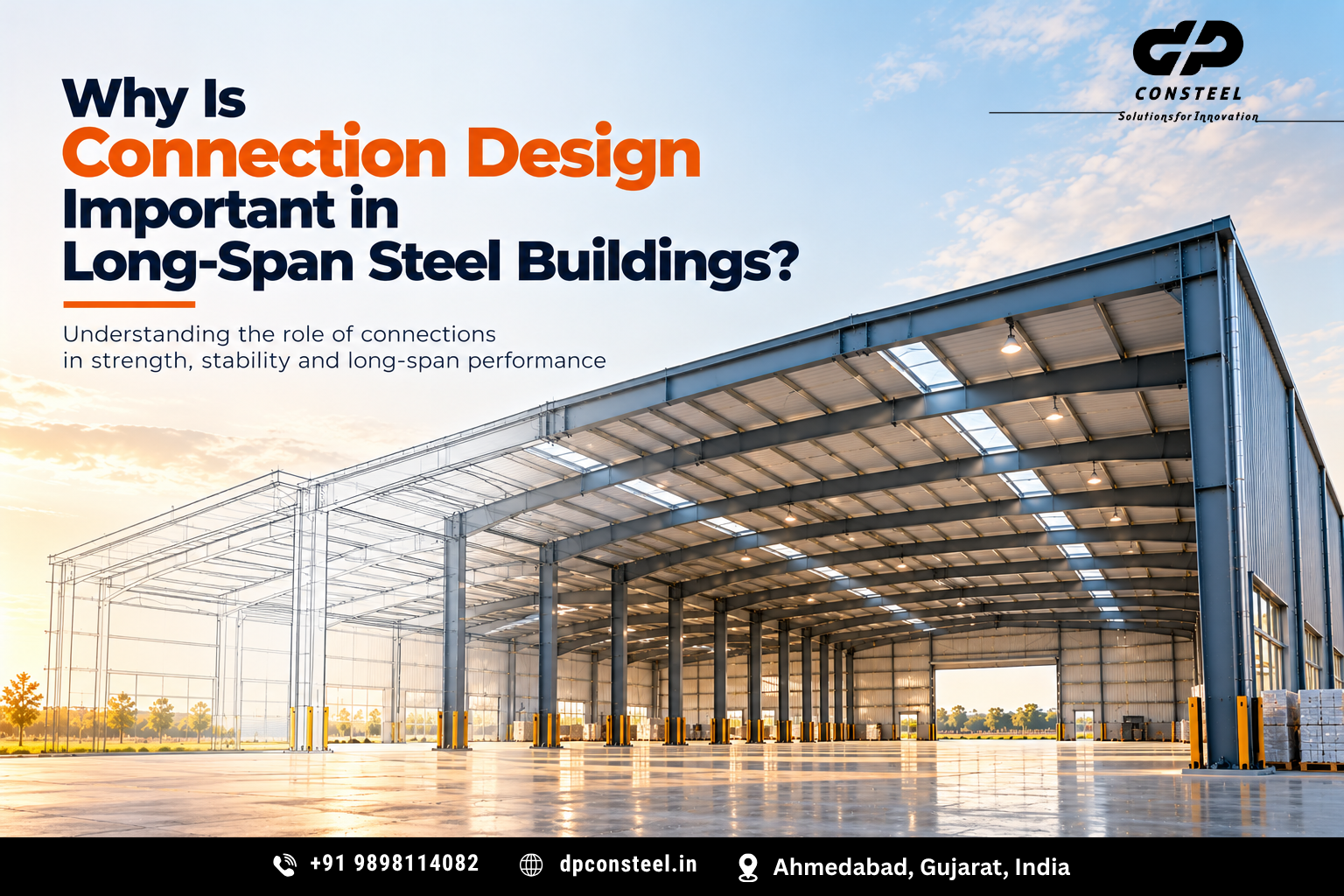
Why Is Connection Design Important in Long-Span Steel Buildings?
Connection Design in Long-Span Steel Buildings
Learn why connection design is important in long-span steel buildings, including load transfer, structural stability, bolted and welded connections, fabrication accuracy, and performance in PEB structures.
Why Is Connection Design Important in Long-Span Steel Buildings?
Long-span steel buildings are widely used for warehouses, factories, logistics centres, aircraft hangars, and large industrial facilities where open internal space is important. These buildings are designed to cover considerable distances with fewer internal columns, allowing businesses to use the available floor area more efficiently.
However, the performance of a long-span steel structure depends on more than the strength of its columns, beams, and roof members. The connections between these components are equally important because they transfer forces from one structural member to another and help the building behave as intended.
Connection design determines how steel members are joined, how forces pass through the joints, and how the structure responds to different loading conditions. If a connection is not suitable for the forces acting on it, the building may experience excessive movement, local deformation, or other structural problems.
This makes connection design an essential part of pre-engineered building (PEB) engineering. For a long-span structure, even small details such as bolt arrangement, plate thickness, weld size, and alignment can influence the performance of the complete structural system.
Understanding the importance of connection design helps project owners, designers, and manufacturers make better decisions when planning industrial buildings.
What Is Connection Design in Steel Structures?
Connection design is the engineering process of determining how two or more structural steel components will be joined and how the resulting joint will transfer forces safely.
Steel buildings contain different types of connections between columns, rafters, beams, bracing members, purlins, and other structural components. Each connection serves a particular purpose based on the building's structural arrangement.
For example, a connection between a column and a rafter may need to transfer bending moment, shear force, and axial force. A bracing connection may primarily transfer axial forces, while a purlin connection supports the roof system and transfers the relevant loads to the main frame.
The connection must be designed according to the forces it is expected to resist, the properties of the connected members, and the intended structural behaviour.
Common connection components include:
-
Bolts: Used to join steel plates and structural members through prepared holes.
-
Welds: Join steel components by creating a welded connection between the required surfaces.
-
Connection plates: Transfer forces between members and provide suitable joining surfaces.
-
Stiffeners: Help resist local forces and reduce the risk of local deformation where required.
-
Cleats and brackets: Provide connection points for secondary members and supporting components.
The selection and arrangement of these components depend on the connection type, design forces, fabrication method, and erection requirements.
Why Is Connection Design Critical in Long-Span Steel Buildings?
1. It Ensures Proper Load Transfer
Every structural member receives forces from the loads acting on the building. These forces must travel through the structural system towards the supports and foundations.
Connections provide the necessary load-transfer paths between the members. For example, roof loads are transferred through the roof system to the primary frames and then towards the columns and foundations.
If a connection cannot safely transfer the forces assigned to it, the intended load path may be compromised.
In long-span steel buildings, this becomes especially important because primary frames often support large roof areas. Their connections must be capable of transferring the forces generated by the building's geometry, loading conditions, and structural arrangement.
Proper connection design helps ensure that the complete structure works as an integrated system rather than as a collection of individual steel members.
2. It Supports Structural Stability
Structural stability refers to the ability of a building to maintain its intended configuration under the loads and conditions considered in its design.
Long-span steel structures may be subjected to dead loads, imposed loads, wind loads, and other applicable actions. Their connections must support the intended structural behaviour under these conditions.
For example, bracing connections help transfer forces through the bracing system, contributing to the building's stability. Connections between primary members also influence how the frame resists the forces acting on it.
If a connection is too flexible, too weak, or inconsistent with the assumptions used in the structural analysis, the building may behave differently from what the design anticipates.
Connection stiffness and strength must therefore be considered alongside the design of the main steel members.
3. It Helps Control Deflection and Structural Movement
Deflection is the movement of a structural member under applied loads. In long-span buildings, controlling deflection is important because roof members and frames may cover substantial distances.
The behaviour of a connection can influence how forces and moments are transferred between members. A connection designed for a particular level of rotational restraint must provide suitable behaviour for that design assumption.
Excessive movement may affect roof cladding, wall panels, drainage arrangements, doors, and other building components. It may also create serviceability concerns even when the members themselves have sufficient strength.
Connection design should therefore be coordinated with the overall structural analysis to achieve appropriate strength, stiffness, and serviceability performance.
4. It Improves Resistance to Wind Forces
Wind loads are an important consideration in industrial buildings, especially those with large roof areas and extensive external wall surfaces.
Wind can produce pressure and suction on the roof and walls. Depending on the building's configuration and location, these forces may affect the main frame, bracing system, roof components, and their connections.
Roof connections and other structural joints must be suitable for the forces identified during design. Connections that resist gravity loads adequately may still require specific checks for wind-induced uplift or other load combinations.
Appropriate detailing helps maintain the continuity of the load path and supports the intended performance of the structure during the design wind conditions.
For long-span PEB buildings, wind-related connection requirements should be considered during the engineering stage rather than addressed only during installation.
What Are the Main Types of Connections Used in Long-Span Steel Buildings?
Different connections are used throughout a steel building depending on the members being joined and the forces they must transfer.
Bolted Connections
Bolted connections use bolts, nuts, and prepared holes to join steel plates and structural members. They are commonly used in steel building fabrication and site erection because they allow components to be assembled using defined procedures.
The design of a bolted connection depends on factors such as bolt diameter, bolt grade, bolt arrangement, plate thickness, edge distances, and the forces acting on the joint.
Depending on the connection and applicable design requirements, checks may include bolt shear, bearing, tension, slip resistance, and the strength of the connected plates.
Correct hole positioning and alignment are also important. Poorly prepared holes or unsuitable bolt arrangements can make erection difficult and may affect the connection's performance.
Welded Connections
Welded connections join steel components through welding processes. They are often used during fabrication to connect plates, stiffeners, flanges, webs, and other components.
The design depends on the type of weld, its effective size and length, the materials being joined, and the forces that must be transferred.
Welding procedures and inspection requirements should be appropriate for the connection and project specifications. Poor weld quality, insufficient weld dimensions, or unsuitable detailing can affect the joint's strength and reliability.
Welded connections also need to be considered in relation to fabrication access, distortion control, and the sequence of manufacturing operations.
Moment Connections
Moment connections are designed to transfer bending moments in addition to the other forces required by the structural system.
They are important in frames where the connection must provide a defined level of rotational restraint. In long-span steel buildings, moment-resisting joints may be used between columns and rafters, depending on the selected frame arrangement.
Their design must account for the forces acting on the connection and the behaviour assumed in the structural analysis.
Bracing Connections
Bracing connections join diagonal or other bracing members to the structural frame. Their purpose is to transfer the forces carried by the bracing system and support the stability of the building.
The connection design must consider the forces in the bracing members, the connected plates, the bolts or welds, and the surrounding structural components.
Correct bracing connection detailing is essential because a bracing member can only contribute effectively to the structural system when its forces can be transferred through its joints.
How Does Connection Design Affect PEB Manufacturing and Installation?
Connection design is not limited to structural calculations. It also influences how steel components are detailed, fabricated, transported, and assembled at the project site.
In pre-engineered buildings, these activities need to be coordinated because the structural members are manufactured before they are erected.
Fabrication Accuracy and Detailing
Connection details provide the information required to manufacture the steel components correctly. Drawings specify plate dimensions, bolt-hole locations, weld details, stiffeners, and other connection requirements.
Accurate detailing helps ensure that the manufactured members fit together according to the approved design.
If holes are positioned incorrectly or connection plates do not match the intended geometry, the fabrication team may need to correct the components. Such problems can lead to delays, additional costs, and difficulties during erection.
For this reason, connection design and fabrication detailing should be coordinated before manufacturing begins.
Ease of Site Erection
A connection may be structurally adequate but difficult to assemble if its details do not account for practical site conditions.
Installation teams need suitable access to bolts, adequate clearance for tools, and sufficient space to position and align the connected members. The erection sequence may also influence how individual joints are assembled.
Well-planned connections can simplify these operations and reduce unnecessary adjustments at the site.
For large industrial buildings, this coordination is particularly valuable because numerous structural members must be assembled in the correct sequence.
Quality Control and Inspection
Connection quality depends on both design and execution. Bolted connections require appropriate bolt specifications, installation procedures, and inspection where applicable. Welded connections require suitable welding procedures and quality checks according to the project requirements.
Inspection helps verify that the completed connections correspond to the approved drawings and specifications.
A consistent quality-control process can identify issues before they affect later stages of construction. It also supports traceability and helps maintain the required fabrication and erection standards.
What Factors Should Be Considered During Connection Design?
Connection design must account for several technical and practical factors to ensure that the joint performs as intended.
Design forces: The connection must resist the relevant axial forces, shear forces, bending moments, and other actions identified through structural analysis.
Member geometry: The size, shape, thickness, and orientation of the connected members influence the connection arrangement.
Material properties: The strength and characteristics of the steel, bolts, weld materials, and connection plates must be suitable for the design requirements.
Connection stiffness: The joint's expected rotational and translational behaviour should be consistent with the assumptions used in the structural analysis.
Fabrication requirements: The connection must be practical to manufacture using the selected processes and available equipment.
Erection conditions: The design should account for access, alignment, assembly sequence, and other site installation requirements.
Durability and environmental exposure: Suitable protection and detailing may be required to address corrosion risks and the building's operating environment.
These factors should be evaluated together. A connection that satisfies one strength check may still require additional assessment for stiffness, local failure modes, fabrication practicality, or durability.
What Problems Can Occur When Connections Are Poorly Designed?
Poor connection design or execution can affect both structural performance and project delivery.
Inadequate connection capacity may lead to local yielding, bolt failure, weld failure, plate deformation, or other forms of damage under the relevant loading conditions.
Incorrect detailing can also create difficulties during fabrication and erection. Misaligned holes, insufficient clearance, or unsuitable plate arrangements may require on-site adjustments that delay the installation process.
Connections that do not provide the intended stiffness may also affect the overall structural response. In some cases, problems may become visible through excessive movement, deformation, or damage to adjoining components.
These risks can be reduced through appropriate engineering calculations, coordinated detailing, quality-controlled fabrication, and inspection during installation.
Connection design should not be treated as a minor drawing detail. It is an essential part of ensuring that the steel structure behaves according to its design requirements.
Why Is Connection Design Especially Important for Long-Span Buildings?
Long-span steel buildings are designed to create large usable spaces with fewer internal supports. This makes them suitable for warehouses, factories, logistics facilities, and other applications requiring open floor areas.
However, longer spans influence the structural arrangement and the forces carried by the main framing system. Depending on the design, the connections may need to transfer significant moments, shear forces, axial forces, or combinations of these actions.
The building's overall stability also depends on the correct interaction between primary frames, bracing systems, roof members, and supporting components.
Connection design must therefore be coordinated with the complete structural system rather than developed independently for each joint.
For a PEB Manufacturer in Ahmedabad, considering connection performance during the design and detailing stages helps coordinate the engineering requirements with fabrication and erection. Similar considerations apply to a PEB Manufacturer in Gujarat working on industrial sheds, warehouses, and other long-span facilities.
How Does Connection Design Support the Long-Term Performance of Steel Buildings?
A well-designed connection helps the building maintain its intended structural performance throughout its service life.
Suitable connection detailing can reduce the risk of premature damage, support reliable load transfer, and make inspection and maintenance more practical.
Protection against corrosion is also important where connections are exposed to moisture, industrial environments, or other potentially aggressive conditions. The appropriate protection system depends on the building's exposure and maintenance requirements.
Periodic inspection can help identify issues such as corrosion, loose or damaged bolts, visible deformation, and deterioration of protective coatings. Any observed problem should be assessed according to its nature and structural significance.
For industrial facilities, long-term performance depends on the combined quality of engineering, materials, fabrication, installation, and maintenance.
Conclusion
Connection design is a fundamental part of long-span steel building engineering because it determines how structural members transfer forces and work together as a complete system.
Bolted, welded, moment, and bracing connections serve different purposes, and each must be designed according to the forces, stiffness requirements, and structural behaviour expected in the building. Proper detailing also supports fabrication accuracy, efficient erection, and effective quality control.
For long-span PEB buildings, connection design must be coordinated with the primary frame, roof system, bracing arrangement, and overall structural analysis. Considering these requirements early helps reduce avoidable fabrication and installation problems while supporting the intended structural performance.
When evaluating a PEB Manufacturer in Ahmedabad, PEB Manufacturer in Gujarat, or PEB Manufacturer in India, businesses should consider how structural engineering, connection detailing, manufacturing, and erection requirements are coordinated within the proposed project.
A carefully engineered connection system helps long-span steel buildings meet their intended strength, stability, serviceability, and durability requirements.