Brochure Download


How Does Steel Move From Raw Material to Finished Structure?
Steel Manufacturing Process: From Raw Material to PEB Structure
Discover how steel moves from raw material to finished structure through material inspection, cutting, drilling, fabrication, welding, quality checks, protective coating, and site erection.
How Does Steel Move From Raw Material to Finished Structure?
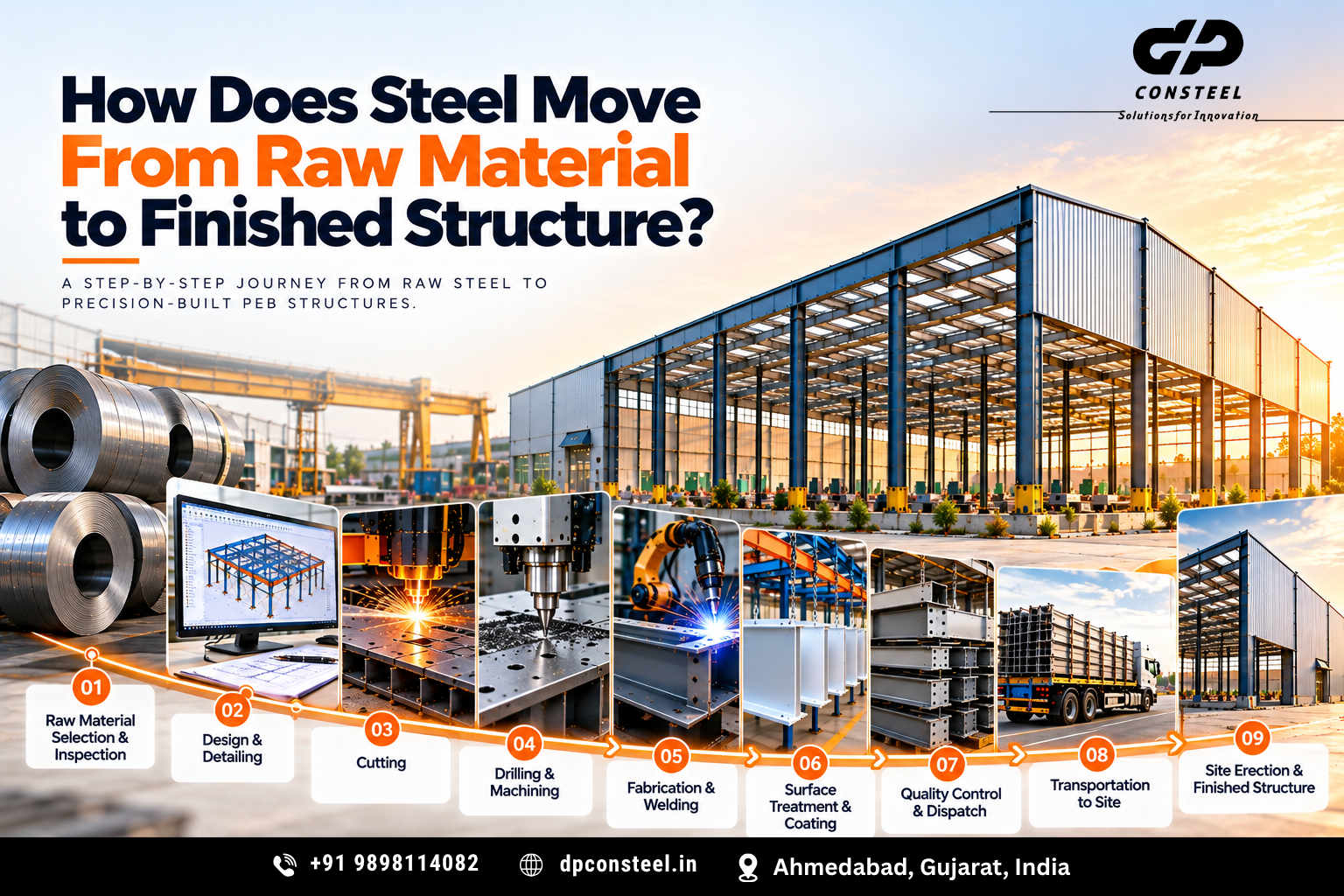
Every steel building begins with raw materials that pass through several stages before becoming part of a completed industrial structure. From material selection and inspection to fabrication, finishing, transportation, and erection, each stage contributes to the final building.
In pre-engineered buildings (PEBs), this process requires coordination between structural engineering, detailed drawings, manufacturing equipment, and quality-control procedures. Steel components must be produced according to approved specifications so that they fit together correctly during assembly.
An experienced PEB Structure Manufacturer in Ahmedabad coordinates these stages to transform raw steel into fabricated components ready for an industrial building project.
What Is the Steel Manufacturing Process?
The steel manufacturing process for a PEB involves preparing raw steel materials and converting them into components required for the building's structural system.
Depending on the project, the process may include material inspection, cutting, drilling, welding, assembly, surface preparation, coating, final inspection, and dispatch.
Each operation follows the approved engineering and fabrication requirements of the project.
Step 1: Raw Material Selection and Inspection
The process begins with selecting the steel plates, sections, coils, and other materials required for the project.
Materials are checked against specified grades, thicknesses, dimensions, and documentation requirements. Material test certificates and identification records may also be reviewed to support traceability.
Proper material verification helps ensure that the correct steel is used for the intended structural components.
Step 2: Structural Design and Detailing
Before manufacturing begins, engineers develop the structural design according to the building's span, height, loading conditions, and intended application.
Detailed drawings then define the dimensions, connections, holes, plates, stiffeners, and other component requirements.
A reliable PEB Manufacturer in Ahmedabad uses approved engineering and fabrication information to guide the manufacturing process.
Step 3: Steel Cutting
After material inspection and drawing verification, steel is cut into the required sizes and shapes.
Depending on the material and component, cutting may be performed using CNC plasma cutting, oxy-fuel cutting, sawing, or other suitable equipment.
Accurate cutting helps prepare components for subsequent drilling, welding, and assembly operations.
Step 4: Drilling and Hole Preparation
Steel components often require holes for bolts and other connection details.
Drilling equipment prepares these holes according to the approved fabrication drawings. Their diameter, position, and spacing are important for proper alignment during assembly.
Accurate hole preparation helps reduce fitting difficulties during fabrication and site erection.
Step 5: Fabrication and Component Assembly
Once the individual steel pieces have been prepared, they are positioned and assembled according to the fabrication drawings.
This stage can involve plates, stiffeners, structural sections, and other components being fitted together to form larger assemblies.
Proper alignment and fit-up are important because errors at this stage can affect subsequent welding and dimensional accuracy.
Step 6: Welding and Structural Fabrication
Welding joins steel components to form the required structural assemblies. Depending on the design, this may include built-up columns, rafters, connection plates, stiffeners, and other fabricated members.
Suitable welding procedures, controlled parameters, trained personnel, and inspection help maintain the specified quality of welded connections.
For a PEB Structure Manufacturer in Gujarat, welding and fabrication procedures need to be coordinated with the approved engineering requirements.
Step 7: Dimensional and Quality Inspection
After fabrication, components are inspected to verify that they meet the required specifications.
Checks may cover member dimensions, alignment, hole positions, weld quality, connection details, and other project-specific requirements.
Depending on the application, visual inspection and appropriate non-destructive testing may also be carried out.
Quality inspection helps identify discrepancies before the components proceed to surface treatment or dispatch.
Step 8: Surface Preparation and Protective Coating
Steel components may require surface preparation before painting or applying another protective coating.
Surface preparation helps remove rust, scale, oil, and other contaminants, depending on the specified preparation method.
The selected coating system depends on the project's environmental conditions and corrosion-protection requirements. Inspection helps verify that the finished surface meets the specified standards.
Step 9: Component Identification and Dispatch
After inspection and finishing, components are identified, organised, and prepared for transportation.
Member marks and dispatch records help match fabricated components with the relevant drawings and their intended positions in the building.
Proper packing and loading arrangements also help protect the components during transportation.
Step 10: Transportation and Site Erection
Fabricated steel components are transported to the project site according to the erection sequence and logistics plan.
At the site, columns, rafters, bracing, purlins, girts, and other members are assembled according to the approved erection drawings.
The completed frame is then coordinated with roofing, wall cladding, and other building elements to form the finished structure.
How Does Digital Technology Support Steel Manufacturing?
Digital tools can connect structural design, detailing, and fabrication. Three-dimensional models provide a visual representation of the building, while CNC systems can use suitable digital manufacturing data for cutting and drilling.
Digital records can also help track components, maintain inspection documentation, and coordinate production activities.
For PEB companies in Ahmedabad, a connected digital workflow can improve coordination between design information and the physical manufacturing process.
Why Is Quality Control Important at Every Stage?
Quality control is not limited to the final inspection. It begins with raw material verification and continues through cutting, drilling, welding, assembly, coating, and dispatch.
Checking components at different stages helps identify problems before they affect later operations.
A structured inspection process also supports traceability and verifies that fabricated components meet the project's specified requirements.
How Does the Process Differ for PEB Structures?
PEB manufacturing combines engineered structural design with the fabrication of individual steel components.
The primary frame, secondary members, connections, bracing, roof system, and wall cladding need to work together according to the approved building design.
An experienced PEB Structure Manufacturer in India coordinates these components so that the fabricated structure can be assembled according to the intended configuration.
Steel Processing for Industrial Shed Manufacturing
Industrial sheds require structural components that match the building's span, height, operational needs, and loading requirements.
The manufacturing workflow may involve cutting, drilling, welding, coating, and inspection of the steel members required for the shed.
For Shed Manufacture, accurate fabrication drawings and proper component identification help connect factory production with site erection.
How Does Material Planning Reduce Waste?
Material planning helps determine the steel grades, dimensions, quantities, and stock sizes required for a project.
Digital nesting and cutting-planning software can help arrange components more efficiently on available steel plates or sections.
Actual material savings depend on component geometry, stock availability, cutting methods, and production planning.
Why Is Coordination Between Manufacturing Stages Important?
Each stage depends on the information and accuracy provided by the previous stage. Incorrect dimensions can affect assembly, while unsuitable surface preparation can affect coating performance.
Coordination between engineering, detailing, fabrication, inspection, and dispatch helps maintain consistency throughout the manufacturing process.
This is especially important for industrial buildings containing numerous interconnected steel components.
Choosing the Right PEB Manufacturing Partner
When comparing PEB companies in Gujarat, businesses can evaluate engineering capabilities, fabrication facilities, cutting and drilling equipment, welding procedures, inspection systems, and project coordination.
A manufacturer with a well-coordinated workflow can manage the transition from raw steel to finished structural components according to the project's requirements.
Businesses evaluating a PEB Manufacturer in Gujarat or PEB Manufacturer in India can also consider how the manufacturer handles material traceability, protective coatings, dispatch planning, and site erection coordination.
Conclusion
Steel moves from raw material to finished structure through a coordinated sequence of engineering, material inspection, cutting, drilling, fabrication, welding, quality checks, surface treatment, transportation, and erection.
Each stage contributes to the dimensional accuracy, fabrication quality, and proper assembly of the final building. Digital tools and systematic inspection can further improve coordination between design and manufacturing.
For businesses evaluating a PEB Structure Manufacturer in Ahmedabad, PEB Structure Manufacturer in Gujarat, or PEB Structure Manufacturer in India, understanding the complete manufacturing process can help them assess a manufacturer's capabilities.
Similarly, when comparing a PEB Manufacturer in Ahmedabad, PEB Manufacturer in Gujarat, PEB Manufacturer in India, PEB companies in Ahmedabad, PEB companies in Gujarat, and PEB companies in India, businesses can consider the manufacturer's engineering, fabrication, quality control, and project coordination processes.
From initial material selection to final Shed Manufacture and site erection, every stage needs to be coordinated to deliver a steel building that meets its approved design and project requirements.