Brochure Download


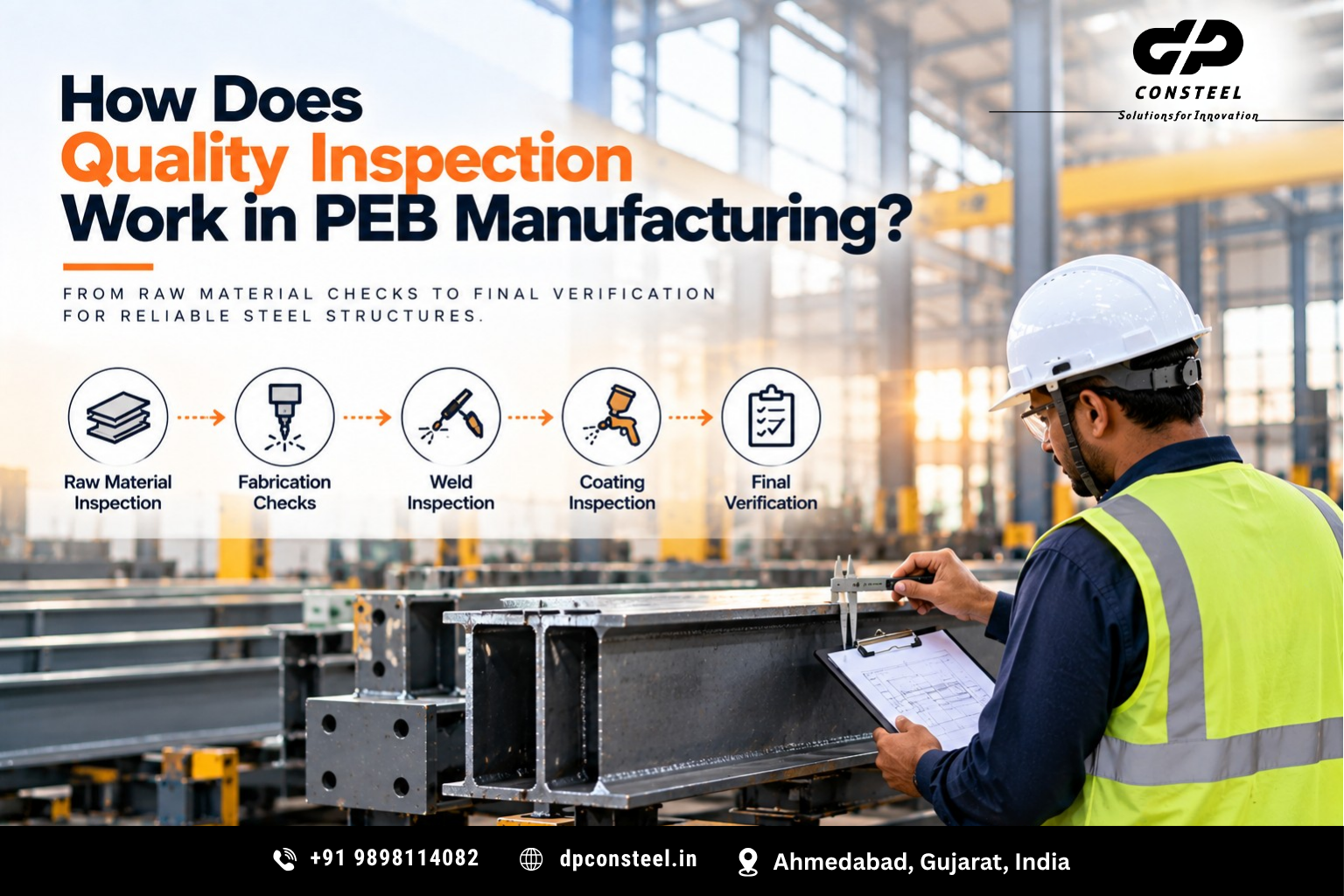
How Does Quality Inspection Work in PEB Manufacturing?
Quality Inspection in PEB Manufacturing: Process & Importance
Learn how quality inspection works in PEB manufacturing, from raw material checks and fabrication inspection to welding, dimensions, coating, and final quality verification.
How Does Quality Inspection Work in PEB Manufacturing?
Quality inspection is an important part of PEB manufacturing because a steel building is made up of many individual components that need to match the approved engineering and fabrication requirements.
From raw material selection to cutting, drilling, welding, assembly, surface treatment, and final dispatch, different stages of manufacturing require appropriate checks.
The purpose of inspection is not simply to identify defects at the end of production. It is also about checking important requirements at different stages so that problems can be identified before they affect subsequent fabrication or erection activities.
For industrial projects, an experienced PEB Structure Manufacturer in Ahmedabad can establish inspection procedures according to the project's structural, fabrication, and quality requirements.
What Is Quality Inspection in PEB Manufacturing?
Quality inspection involves checking materials, dimensions, fabrication processes, welded connections, surface preparation, coatings, and finished components against specified requirements.
The exact inspection process depends on the type of component, material, welding procedure, project specifications, and applicable standards.
Inspection records can also provide traceability throughout the manufacturing process.
Why Is Quality Inspection Important?
PEB structures contain numerous primary and secondary steel components. These components need to be manufactured according to approved drawings so they can be assembled correctly at the project site.
Inspection helps verify that the manufactured components meet the required dimensions, material specifications, connection details, and fabrication requirements.
For a PEB Manufacturer in Ahmedabad, maintaining systematic quality checks can help connect engineering requirements with actual production.
Raw Material Inspection
Quality inspection can begin before fabrication starts.
Steel plates, sections, coils, bolts, welding consumables, and other materials may need to be checked against the specified material requirements.
Depending on the project, documentation such as material test certificates may also be reviewed to establish material traceability.
Checking Material Specifications
Different structural components can require specific steel grades, thicknesses, dimensions, or other material properties.
The material received for fabrication should correspond with the approved specifications.
Proper identification and documentation help ensure that the correct material is used for the intended component.
Inspection During Cutting
Cutting is one of the first major fabrication operations. Steel plates and sections need to be cut according to the approved fabrication drawings.
Dimensional checks can verify the length, width, shape, and other required details of the cut component.
For projects involving numerous components, CNC cutting can help maintain repeatability, while inspection verifies that the finished pieces meet the required dimensions.
Drilling and Hole Inspection
Structural components often require holes for bolted connections.
Hole diameter, location, spacing, and alignment can be important for proper assembly.
Inspection during drilling helps verify that connection holes correspond with the approved fabrication details.
How Is Welding Inspected in PEB Manufacturing?
Welding is a major part of steel fabrication, particularly for built-up structural members and various connection assemblies.
Inspection may involve checking joint preparation, welding parameters, weld appearance, dimensions, and other requirements specified by the applicable welding procedure.
Depending on project requirements, additional testing methods may also be used to evaluate weld quality.
Welding Procedure and Process Control
Welding procedures establish how specific welds should be produced. They can include information about materials, joint configuration, welding process, consumables, and relevant parameters.
Following an approved procedure helps maintain consistency during fabrication.
A PEB Structure Manufacturer in Gujarat can incorporate welding inspection and process control into its manufacturing quality system.
Visual Inspection of Welds
Visual inspection is one of the common methods used to examine completed welds.
Inspectors can check aspects such as weld appearance, visible discontinuities, dimensions, surface condition, and conformity with specified requirements.
Visual inspection can be performed during fabrication as well as after welding operations are completed.
Non-Destructive Testing
Depending on the project and component requirements, non-destructive testing methods may be used to identify discontinuities that may not be visible during a basic visual inspection.
Methods can include techniques such as ultrasonic testing, magnetic particle testing, dye penetrant testing, or radiographic testing, depending on the application and specified requirements.
The appropriate method depends on the weld type, material, project specifications, and applicable standards.
Dimensional Inspection
Dimensional accuracy is important because steel components need to fit together during assembly and site erection.
Measurements can include member length, overall dimensions, hole locations, connection positions, squareness, alignment, and other project-specific requirements.
Dimensional inspection helps verify that fabricated components correspond with the approved drawings.
Inspection of Primary Members
Primary structural members such as columns and rafters form the main load-carrying system of a PEB.
These components may require checks for dimensions, welding, connection details, stiffeners, plates, and other fabrication requirements.
Accurate inspection helps ensure that the primary members are ready for subsequent assembly and erection.
Inspection of Secondary Members
Secondary components such as purlins, girts, bracing members, stiffeners, and other elements also need to meet their specified dimensions and connection requirements.
Although these members may be smaller than the primary frame, inaccuracies can still create assembly difficulties.
For PEB companies in Ahmedabad, systematic inspection of both primary and secondary members is an important part of fabrication control.
Surface Preparation Inspection
After fabrication, steel components may undergo surface preparation before protective coating.
Surface preparation helps remove contaminants, rust, scale, or other unwanted material from the steel surface.
The required preparation method and level depend on the specified coating system and project requirements.
Paint and Coating Inspection
Protective coatings can help protect structural steel against environmental exposure and corrosion.
Inspection may include checking coating coverage, surface condition, and dry film thickness according to the specified requirements.
Proper coating inspection helps verify that the finished components meet the project's protective coating specifications.
Bolt and Connection Inspection
Bolted connections are important during the erection of PEB structures.
Inspection can involve checking bolt specifications, hole alignment, connection components, and tightening requirements according to the approved design and applicable procedures.
Correct connection preparation helps support accurate site assembly.
Final Dimensional Inspection
Before components are dispatched, a final inspection can be carried out to verify that the finished members meet the approved fabrication requirements.
This may include checking overall dimensions, connection locations, identification marks, surface condition, coating, and other relevant details.
Final inspection provides an additional verification stage before transportation to the project site.
Component Identification and Traceability
Large PEB projects can contain hundreds or thousands of individual components.
Proper identification helps ensure that each component can be matched with its fabrication drawings and intended location within the building.
Marking and documentation can therefore support smoother assembly and erection at the project site.
Quality Inspection and CNC Fabrication
Modern PEB manufacturing may use CNC machines for cutting, drilling, and other fabrication operations.
Although automated equipment improves repeatability, inspection remains necessary to verify the finished components.
For Shed Manufacture, combining automated fabrication with dimensional inspection can help maintain consistency across large production batches.
Inspection Records
Quality documentation can provide a record of inspections performed during manufacturing.
Depending on the project, records may include material documentation, dimensional inspection reports, welding inspection records, coating checks, testing reports, and final inspection documents.
These records can support traceability and project quality management.
Quality Inspection Before Dispatch
Before fabricated components leave the manufacturing facility, they can be checked against the dispatch requirements.
Components may be verified for identification, quantity, dimensions, surface condition, packaging, and loading arrangements.
Proper dispatch preparation can reduce confusion when materials arrive at the project site.
How Does Inspection Support Site Erection?
Accurate fabrication makes the erection process more predictable because components are manufactured according to the approved drawings.
When columns, rafters, secondary members, plates, and connections correspond correctly, site teams can assemble the structure according to the intended configuration.
This demonstrates why quality inspection is connected not only to manufacturing but also to site erection.
Quality Control in Different PEB Projects
Different buildings can have different inspection requirements. A warehouse, factory, crane building, high-bay structure, or industrial shed may involve different structural components and project specifications.
An experienced PEB Structure Manufacturer in India can establish inspection procedures according to the requirements of the specific project.
Role of Quality Inspection in PEB Companies
When evaluating PEB companies in Gujarat, businesses can consider their quality-control procedures, inspection infrastructure, fabrication capabilities, documentation practices, and ability to maintain consistency across production.
Quality management should be integrated into the manufacturing process rather than treated as a final-stage activity only.
Choosing a Manufacturer With Quality-Control Systems
A manufacturer working on large steel structures needs coordination between engineering, procurement, fabrication, inspection, coating, dispatch, and erection.
An experienced PEB Manufacturer in India can integrate quality inspection throughout these stages according to project requirements.
Businesses can also review the manufacturer's fabrication infrastructure and quality procedures when comparing potential manufacturing partners.
Conclusion
Quality inspection in PEB manufacturing works as a continuous process that covers multiple stages of production. It can begin with raw material verification and continue through cutting, drilling, welding, dimensional checks, surface preparation, coating, assembly, and final dispatch inspection.
The purpose is to verify that fabricated components correspond with the approved engineering and fabrication requirements before they reach the project site.
For businesses evaluating a PEB Structure Manufacturer in Ahmedabad, PEB Structure Manufacturer in Gujarat, or PEB Structure Manufacturer in India, quality-control procedures are an important part of understanding the manufacturing process.
Similarly, when comparing a PEB Manufacturer in Ahmedabad, PEB Manufacturer in Gujarat, PEB Manufacturer in India, PEB companies in Ahmedabad, PEB companies in Gujarat, and PEB companies in India, businesses can consider engineering capabilities, fabrication technology, inspection procedures, documentation, and project coordination.
Proper quality inspection also plays an important role in Shed Manufacture, helping ensure that the individual steel components are prepared according to the requirements of the complete industrial building.