Brochure Download


How Does Digital Technology Improve PEB Manufacturing?
Digital Technology in PEB Manufacturing: Accuracy, Speed & Control
Learn how digital technology improves PEB manufacturing through 3D modelling, CNC fabrication, automated processes, digital coordination, quality control, and production planning
How Does Digital Technology Improve PEB Manufacturing?
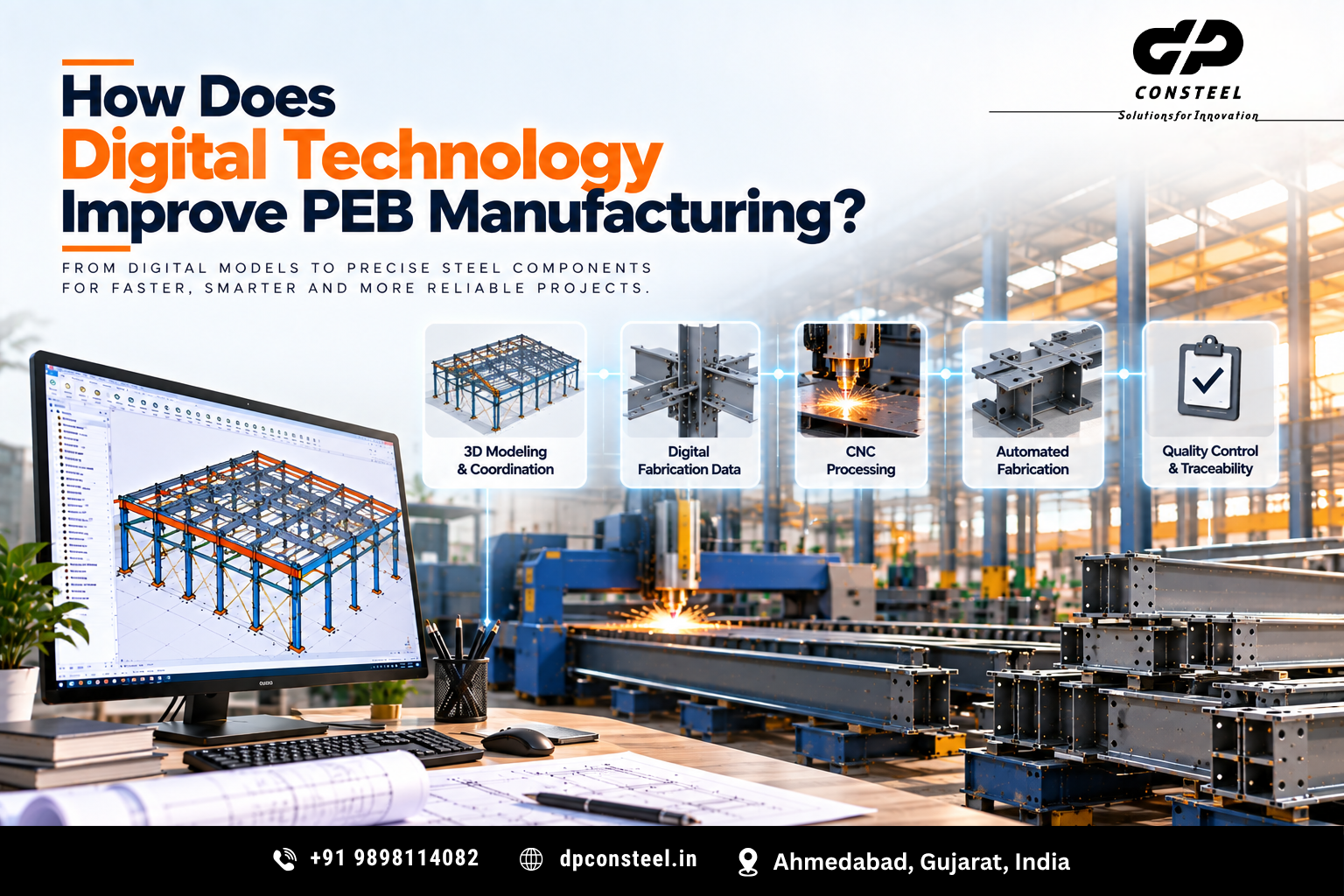
PEB manufacturing has evolved with the introduction of digital tools that connect structural design, detailing, fabrication, inspection, and project coordination. Instead of treating each manufacturing stage as a separate process, digital technology can create a more connected workflow from the initial model to the finished steel component.
Technologies such as 3D structural modelling, CNC machinery, automated fabrication, digital production planning, and computerised quality-control systems can improve the way steel components are prepared and manufactured.
For industrial projects, an experienced PEB Structure Manufacturer in Ahmedabad can use these technologies to improve coordination between engineering information and physical fabrication.
What Is Digital Technology in PEB Manufacturing?
Digital technology in PEB manufacturing refers to the use of software, computerised machinery, automation, and digital information throughout the manufacturing process.
This can include 3D structural modelling, fabrication detailing, CNC cutting and drilling, automated welding, production planning, digital inspection records, and other connected manufacturing processes.
The objective is to make manufacturing more controlled, traceable, and consistent.
Why Is Digital Technology Important for PEB Manufacturing?
PEB projects involve a large number of individual steel components. Each component has specific dimensions, connection details, material requirements, and identification information.
Digital systems can help manage this information more efficiently.
When engineering and fabrication information is properly coordinated, manufacturing teams can work from more detailed and consistent data.
How Does 3D Modelling Support Manufacturing?
3D structural modelling allows the complete steel structure to be represented digitally before fabrication begins.
Columns, rafters, purlins, girts, bracing, plates, bolts, stiffeners, and connections can be modelled and reviewed.
This makes it possible to identify coordination issues before steel reaches the fabrication floor.
A PEB Manufacturer in Ahmedabad can use detailed digital models as a connection between structural engineering and fabrication.
Digital Detailing and Fabrication
Detailed digital models can be used to generate fabrication drawings and component information.
These drawings can include dimensions, connection details, member marks, hole locations, plate sizes, weld information, and assembly requirements.
This creates a more direct connection between the approved structural design and the manufacturing process.
How Does CNC Technology Improve PEB Manufacturing?
CNC machinery can perform cutting, drilling, and other fabrication operations according to programmed digital information.
Compared with manually measuring every component, CNC processes can provide greater repeatability for suitable manufacturing operations.
CNC technology can therefore help reduce dimensional variation and improve production consistency when properly programmed and maintained.
Digital Technology and Automated Welding
Automated welding systems can perform repetitive welding operations using controlled movements and predefined parameters.
This can provide greater consistency for suitable components and repetitive production tasks.
However, automation still requires appropriate setup, welding procedures, equipment maintenance, inspection, and skilled supervision.
How Does Digital Technology Improve Fabrication Accuracy?
Digital workflows can reduce the amount of manual information transfer between design and manufacturing.
When dimensions, connection details, member identification, and fabrication information are generated from a coordinated digital model, the possibility of transcription or interpretation errors can be reduced.
Actual fabrication accuracy still depends on machine calibration, material preparation, fit-up, welding, inspection, and overall production control.
Digital Production Planning
Manufacturing a PEB requires coordination of materials, machines, manpower, fabrication sequences, inspection, and dispatch.
Digital production planning can help organise these activities and provide better visibility into the manufacturing process.
Production teams can use digital information to plan component sequences, track progress, and coordinate different fabrication stages.
Digital Material Management
Digital systems can help track steel materials from procurement through fabrication.
Material identification, component requirements, quantities, and production information can be recorded and coordinated with project documentation.
This can improve traceability and help reduce confusion when a project contains a large number of similar components.
Digital Technology and Material Optimisation
Digital fabrication software can support planning for cutting steel plates and sections.
Nesting and cutting optimisation can help arrange components more efficiently on available material.
Actual material savings depend on component geometry, stock sizes, cutting methods, and production planning, but digital tools can support more informed material utilisation.
Digital Quality Control
Quality control is an important part of PEB manufacturing.
Digital systems can help record inspection information for dimensions, welding, materials, coating, and finished components.
Inspection records can also be linked to component identification, making it easier to trace a particular component through the manufacturing process.
Digital Inspection and Dimensional Checks
Modern inspection processes can use digital measuring equipment and computerised records to verify fabricated components.
Dimensions can be checked against approved fabrication information to identify variations before components are dispatched.
This creates an additional connection between the digital model and physical steel.
Digital Technology and PEB Manufacturing Workflow
A connected digital workflow can follow a sequence such as:
Structural Design → 3D Detailing → Fabrication Data → CNC Processing → Welding & Assembly → Quality Inspection → Dispatch
Each stage can use information generated or verified during the previous stage.
This can reduce unnecessary duplication of information and improve coordination across the manufacturing process.
Digital Technology for Primary Steel Members
Primary members such as columns and rafters often involve detailed fabrication requirements.
Digital modelling and CNC processes can help manage dimensions, plates, stiffeners, holes, welds, and connection information.
For PEB companies in Ahmedabad, digital workflows can be particularly useful when producing large quantities of structural components.
Digital Technology for Secondary Members
Secondary members such as purlins, girts, bracing, and other components also require accurate fabrication information.
Digital systems can help manage their dimensions, identification, connection requirements, and production sequence.
This allows primary and secondary structural components to remain coordinated throughout manufacturing.
How Does Digital Technology Improve Traceability?
Traceability means being able to identify where a material or component came from and how it moved through the manufacturing process.
Digital identification systems can connect material information, component marks, fabrication drawings, inspection records, and dispatch information.
This can be valuable for large PEB projects containing many individual steel components.
Digital Technology in Industrial Shed Manufacturing
Industrial sheds can involve extensive steel framing and large quantities of fabricated components.
Digital manufacturing systems can help coordinate structural detailing, CNC processing, welding, inspection, and assembly.
For Shed Manufacture, this connected approach can help improve consistency and project coordination.
Digital Technology and BIM
BIM can provide a digital representation of the building and its components.
For steel structures, BIM and detailed 3D modelling can help coordinate the structural frame, connections, building services, and other project requirements.
The resulting information can then support downstream detailing and manufacturing processes where appropriate.
Digital Technology and Clash Detection
Digital models can help identify potential clashes between structural members and other building elements.
A connection, brace, duct, crane component, opening, or service route can be reviewed before fabrication begins.
Resolving such issues digitally can help reduce avoidable modifications during manufacturing or site erection.
Digital Technology and Project Communication
A digital model and shared project information can improve communication between engineers, detailers, fabrication teams, quality inspectors, and site personnel.
Teams can refer to the same component information and drawings when discussing fabrication or erection requirements.
This can be especially useful for complex industrial projects.
Digital Technology and Future Modifications
Digital records can also be useful after the initial construction is complete.
A properly maintained digital model can provide information about existing structural members, connections, and building configuration if future expansion or modification is required.
This can support better planning for changes to the facility.
Does Digital Technology Replace Skilled Workers?
No. Digital technology supports skilled professionals rather than completely replacing them.
Engineers, detailers, machine operators, welders, inspectors, production planners, and quality-control teams are still required.
Technology provides tools for improving accuracy, consistency, communication, and production control, while human expertise remains important for decision-making and problem-solving.
Digital Technology and Quality Assurance
Digital manufacturing should still operate alongside established quality procedures.
Automated equipment can produce repeatable results, but materials, machines, welds, dimensions, coatings, and finished assemblies still need appropriate inspection.
An experienced PEB Structure Manufacturer in Gujarat can combine digital manufacturing tools with established quality-control procedures.
Choosing a Digitally Equipped PEB Manufacturer
When comparing PEB companies in Gujarat, businesses can consider their use of 3D detailing software, CNC machinery, automated fabrication, digital inspection systems, production planning tools, and quality-control processes.
A manufacturer with a connected digital workflow can provide better coordination between engineering information and physical manufacturing.
Digital Technology and PEB Manufacturing in India
The adoption of digital manufacturing technologies can help PEB manufacturers manage increasingly detailed and customised industrial projects.
An experienced PEB Structure Manufacturer in India can use digital tools according to project size, component complexity, production requirements, and applicable quality standards.
Choosing the Right PEB Manufacturing Partner
When evaluating a PEB Manufacturer in Ahmedabad, PEB Manufacturer in Gujarat, or PEB Manufacturer in India, businesses can look beyond the final steel structure and understand how the manufacturer manages the complete manufacturing workflow.
Engineering capability, detailing, CNC fabrication, welding, inspection, traceability, quality control, and project coordination all contribute to the final result.
Conclusion
Digital technology improves PEB manufacturing by connecting structural design, detailing, fabrication, inspection, and project coordination through a more integrated workflow.
3D modelling can improve visualisation and coordination, CNC machinery can support repeatable fabrication, automated welding can improve consistency, and digital inspection systems can strengthen quality control and traceability.
For businesses evaluating a PEB Structure Manufacturer in Ahmedabad, PEB Structure Manufacturer in Gujarat, or PEB Structure Manufacturer in India, digital manufacturing capabilities can be considered alongside engineering expertise, fabrication infrastructure, and quality-control systems.
Similarly, when comparing a PEB Manufacturer in Ahmedabad, PEB Manufacturer in Gujarat, PEB Manufacturer in India, PEB companies in Ahmedabad, PEB companies in Gujarat, and PEB companies in India, understanding how digital technology is integrated into Shed Manufacture and the wider PEB production workflow can help businesses make a more informed decision.