Brochure Download


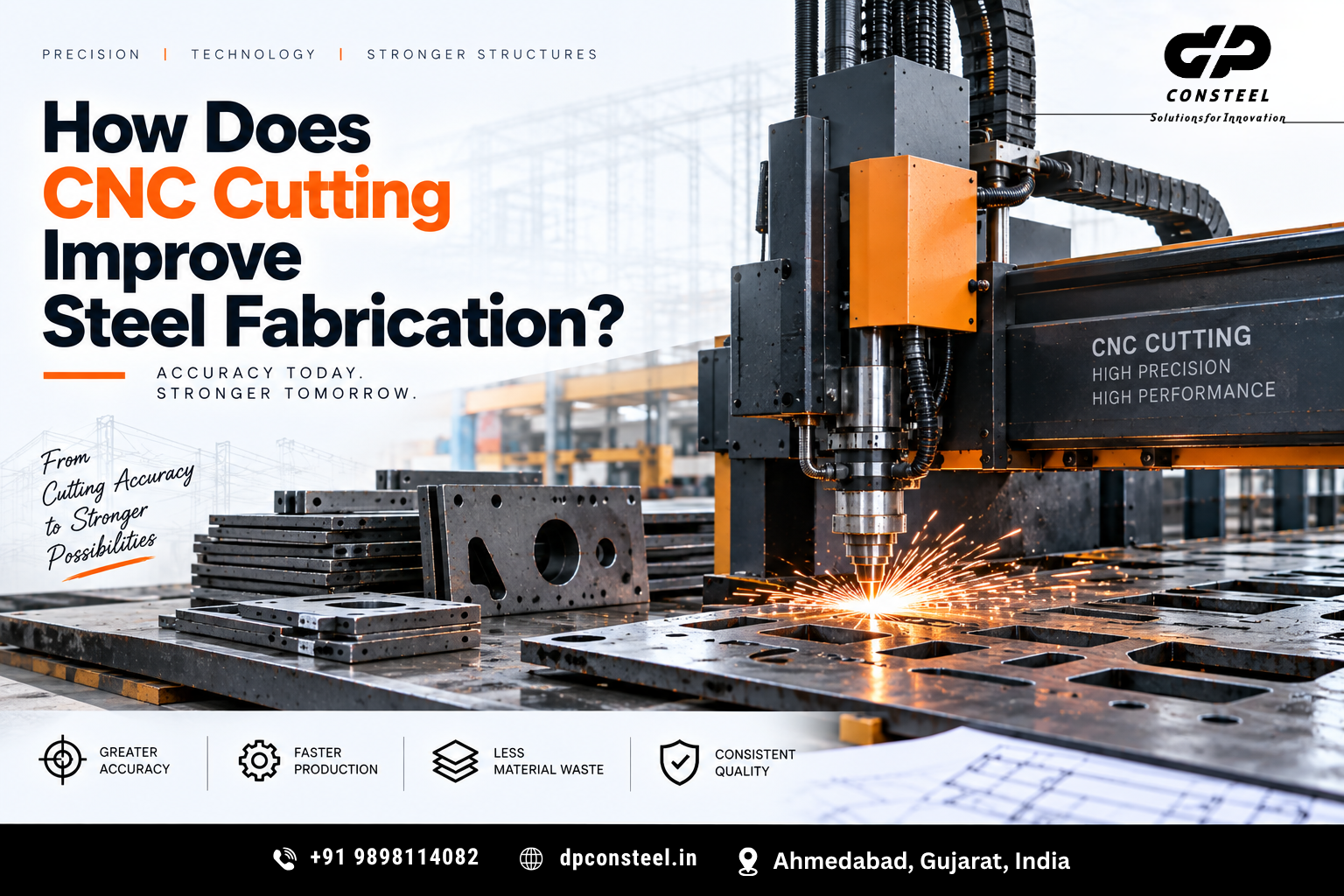
How Does CNC Cutting Improve Steel Fabrication?
CNC Cutting in Steel Fabrication: Accuracy, Speed & Quality
Learn how CNC cutting improves steel fabrication through accurate dimensions, consistent cutting, reduced material waste, faster production, and better fabrication quality.
How Does CNC Cutting Improve Steel Fabrication?
Steel fabrication requires accuracy at every stage. From preparing raw steel plates to producing components that need to fit together during assembly, even small dimensional variations can affect the overall fabrication process.
CNC cutting has become an important part of modern steel fabrication because it uses computer-controlled machinery to cut steel according to digitally prepared design information. This allows fabrication teams to produce components with controlled dimensions and repeatable cutting patterns.
For PEB structures, industrial sheds, warehouses, factories, and other steel buildings, accurate cutting can help connect engineering and fabrication more efficiently.
An experienced PEB Structure Manufacturer in Ahmedabad can integrate CNC cutting with structural detailing and fabrication processes to produce steel components according to project-specific requirements.
What Is CNC Cutting in Steel Fabrication?
CNC stands for Computer Numerical Control. In steel fabrication, CNC machines use programmed digital information to control cutting operations.
Instead of manually measuring and cutting every component, the machine follows predefined dimensions and cutting paths from the approved fabrication information.
Depending on the equipment and material, CNC cutting can be used for steel plates, sections, connection plates, brackets, and other fabricated components.
Why Is Cutting Accuracy Important?
Accurate cutting is important because fabricated steel components need to match the dimensions specified in the structural and fabrication drawings.
A component that is cut incorrectly may create difficulties during drilling, welding, assembly, transportation, or site erection.
CNC cutting helps maintain controlled dimensions across repeated components and reduces dependence on manual measurement for every individual cut.
How Does CNC Cutting Reduce Human Error?
Manual cutting involves measurement, marking, positioning, and cutting operations that can introduce variations if not carefully controlled.
CNC systems use programmed information to guide the cutting process. Once the correct parameters and dimensions are established, the machine can repeat the same cutting pattern across multiple components.
This consistency can be particularly useful when a project requires a large number of similar steel parts.
CNC Cutting and PEB Manufacturing
PEB manufacturing involves producing many steel components according to detailed engineering information. Primary members, secondary members, connection plates, stiffeners, brackets, and other components may require specific dimensions and cutting patterns.
CNC cutting provides a direct connection between digital fabrication information and the physical steel component.
A PEB Manufacturer in Ahmedabad can use this approach to support consistent fabrication across different PEB projects.
Role of Digital Fabrication Data
Modern steel fabrication often begins with digital structural models and detailed fabrication drawings. These drawings contain information such as dimensions, component identification, hole locations, connection details, and other manufacturing requirements.
CNC machinery can use appropriate digital information to control cutting operations.
This reduces the need to repeatedly transfer dimensions manually from drawings to individual steel components.
How Does CNC Cutting Improve Production Speed?
CNC cutting can improve production efficiency by automating repetitive cutting operations.
Once the machine has been programmed and the material is correctly positioned, multiple components can be processed according to the programmed cutting pattern.
The actual production time depends on the material thickness, component geometry, machine capacity, cutting method, and production requirements.
For PEB companies in Ahmedabad, efficient cutting can support smoother movement of components through subsequent fabrication stages.
How Does CNC Cutting Reduce Material Waste?
Material utilisation is an important consideration in steel fabrication. When several components need to be cut from steel plates, the arrangement of those components can influence how much material remains unused.
Computer-controlled cutting can use planned cutting layouts to organise components efficiently on available material.
Better material utilisation can help reduce avoidable scrap, although actual material savings depend on component geometry, plate dimensions, nesting arrangements, and project requirements.
CNC Cutting Improves Repeatability
Repeatability is one of the major benefits of computer-controlled fabrication. If several components have the same dimensions, CNC machinery can reproduce the programmed cutting pattern consistently.
This is useful for PEB projects where multiple similar plates, brackets, stiffeners, or other components may be required.
Consistent components can also support smoother assembly and fabrication operations.
Better Accuracy for Connection Components
Steel structures contain numerous connections between primary and secondary members. Connection plates, brackets, stiffeners, and other components need to be manufactured according to approved details.
Accurate cutting helps prepare these components with the required dimensions before they move to drilling, welding, or assembly.
For a PEB Structure Manufacturer in Gujarat, this accuracy can help maintain better coordination between engineering drawings and fabrication activities.
CNC Cutting and Structural Detailing
CNC cutting works most effectively when the fabrication information is accurate. Structural detailing therefore remains an important part of the overall process.
The detailer prepares fabrication information based on the approved structural design. This information can then be used to guide manufacturing operations.
The relationship between detailing and CNC cutting creates a digital connection between structural engineering and physical fabrication.
CNC Cutting for Primary Steel Components
Primary structural members carry major forces within a PEB. Their dimensions and fabrication requirements are determined through structural engineering.
CNC-based cutting and preparation can support the manufacturing of plates and components used in primary framing.
The actual fabrication process depends on the structural configuration, material specifications, equipment, and approved manufacturing drawings.
CNC Cutting for Secondary Components
Secondary components such as purlins, girts, bracing elements, stiffeners, plates, and other supporting parts may also require controlled cutting and preparation.
When many similar components are required, CNC equipment can provide consistent production according to the programmed information.
This helps maintain coordination between different stages of fabrication.
How Does CNC Cutting Support Quality Control?
Quality control begins with correct design information and continues through material preparation, cutting, drilling, welding, inspection, and finishing.
CNC cutting provides controlled machine-based production, but inspection remains important to verify that the finished components meet the required specifications.
Dimensions, component identification, cutting quality, and other relevant characteristics can be checked according to the project's quality requirements.
CNC Cutting and Faster Fabrication
CNC cutting can reduce repetitive manual operations and help organise the production sequence.
Once components are programmed and prepared correctly, the machine can process them consistently, allowing fabrication teams to move components toward drilling, welding, assembly, and inspection.
This can contribute to a more organised fabrication workflow.
Does CNC Cutting Eliminate Manual Fabrication?
No. CNC cutting is one part of the steel fabrication process.
After cutting, components may still require drilling, welding, fitting, assembly, inspection, surface preparation, coating, and other operations depending on their design.
Skilled fabrication teams remain important for coordinating these processes and ensuring that the final components meet the required specifications.
CNC Technology in Industrial Shed Manufacturing
Industrial sheds can contain a large number of structural steel components that need to be manufactured according to project-specific drawings.
CNC cutting can support the production of plates and other components used in industrial shed fabrication.
This makes CNC technology relevant to Shed Manufacture, particularly when projects involve repeated components and detailed steel fabrication requirements.
How Does CNC Cutting Support PEB Companies in Gujarat?
Modern fabrication technologies can help PEB companies in Gujarat improve production coordination and maintain consistency across different projects.
However, CNC machinery alone does not determine fabrication quality. Engineering, detailing, material quality, machine calibration, programming, inspection, and skilled fabrication all contribute to the final result.
CNC Cutting for Projects Across India
Large industrial projects may require thousands of individual steel components with different dimensions and fabrication details.
A PEB Structure Manufacturer in India can use CNC-based fabrication as part of an integrated manufacturing process where engineering information is connected with production activities.
The actual technology and equipment used depend on the manufacturer's facilities and project requirements.
Choosing a Manufacturer With CNC Fabrication Capability
When evaluating PEB companies in India, businesses can consider the manufacturer's engineering capabilities, fabrication infrastructure, CNC equipment, quality-control procedures, detailing process, and project experience.
The ability to connect digital design information with fabrication can be particularly useful for projects requiring high levels of dimensional consistency.
An experienced PEB Manufacturer in India can coordinate these stages as part of the overall manufacturing workflow.
CNC Cutting and Project Efficiency
The value of CNC cutting is not limited to faster cutting. Its importance also comes from the connection between digital information, repeatable production, material utilisation, and fabrication accuracy.
When properly integrated into the manufacturing process, CNC cutting can help create a more controlled workflow from structural detailing to finished steel components.
Choosing the Right PEB Manufacturing Partner
For businesses planning warehouses, factories, industrial sheds, and other steel structures, the manufacturing process should be evaluated as a complete system.
A PEB Manufacturer in Ahmedabad, PEB Manufacturer in Gujarat, or PEB Manufacturer in India can support the project through engineering, detailing, material procurement, CNC fabrication, quality inspection, finishing, and dispatch.
Understanding the manufacturer's fabrication capabilities can help businesses select a process that matches their project's requirements.
Conclusion
CNC cutting improves steel fabrication by bringing computer-controlled accuracy and repeatability into the cutting stage. It can help reduce dimensional variations, improve production consistency, support material utilisation, and create a stronger connection between digital detailing and physical fabrication.
For PEB structures and industrial steel buildings, CNC cutting works as one part of a larger manufacturing process that includes engineering, detailing, fabrication, inspection, and finishing.
Businesses evaluating a PEB Structure Manufacturer in Ahmedabad, PEB Structure Manufacturer in Gujarat, or PEB Structure Manufacturer in India can consider CNC fabrication capabilities along with engineering expertise, quality control, manufacturing infrastructure, and project experience.
Similarly, when comparing a PEB Manufacturer in Ahmedabad, PEB Manufacturer in Gujarat, PEB Manufacturer in India, PEB companies in Ahmedabad, PEB companies in Gujarat, and PEB companies in India, the complete connection between design, fabrication technology, and quality control is an important consideration for modern steel construction.