Brochure Download


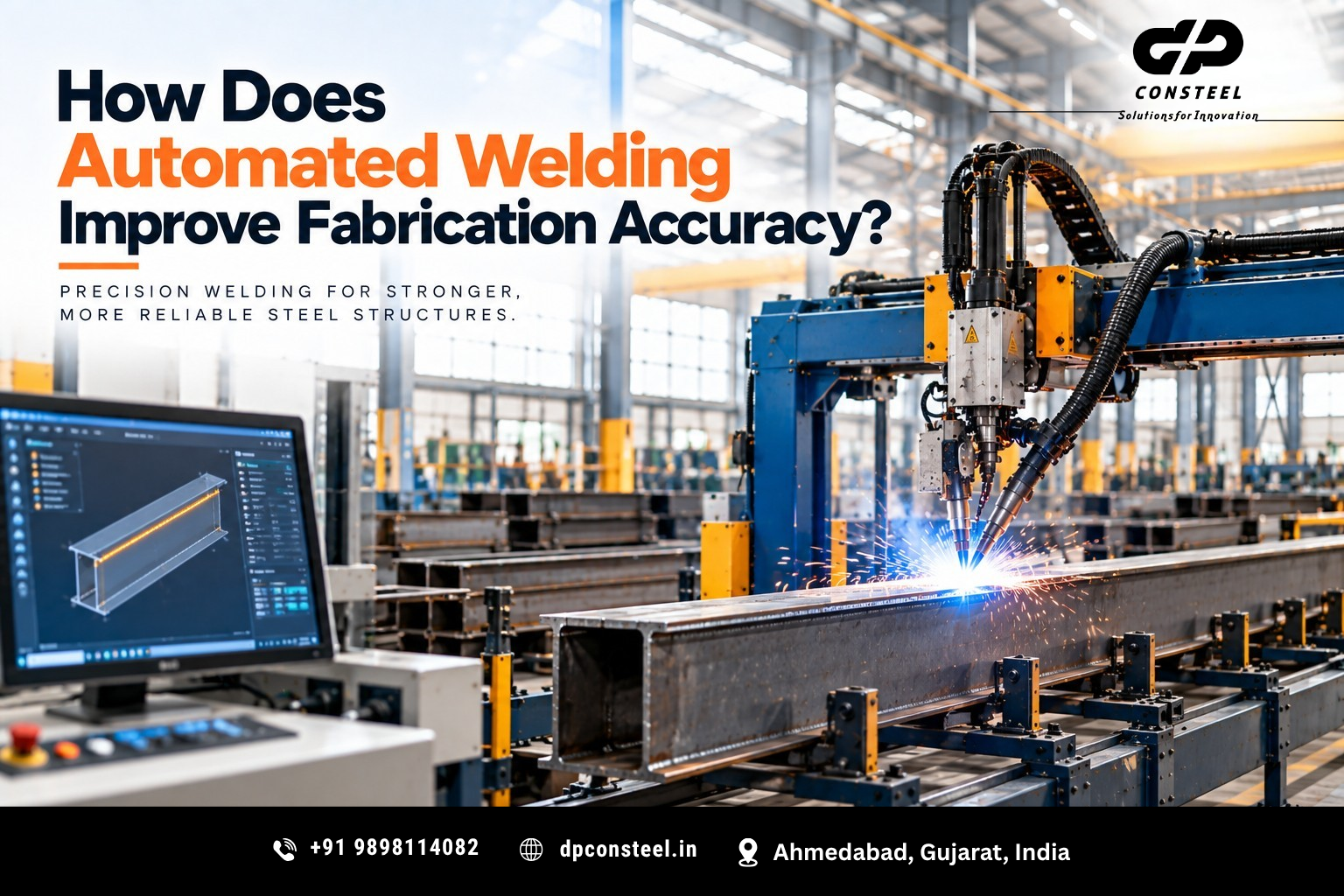
How Does Automated Welding Improve Fabrication Accuracy?
Automated Welding in Steel Fabrication: Accuracy & Quality
Learn how automated welding improves steel fabrication accuracy through consistent welds, controlled parameters, better repeatability, reduced errors, and improved production quality.
How Does Automated Welding Improve Fabrication Accuracy?
Welding is an important part of steel fabrication because it connects individual components to create complete structural assemblies. In industrial buildings and PEB structures, the quality and consistency of welded connections can influence fabrication accuracy and assembly.
Automated welding uses programmed equipment and controlled welding parameters to perform repetitive welding operations with greater consistency. Instead of relying entirely on manual movement and positioning, automated systems can maintain a predefined welding path, speed, and other process parameters.
This can be particularly useful when a project contains a large number of similar welded components.
An experienced PEB Structure Manufacturer in Ahmedabad can integrate automated welding into the fabrication process to improve consistency between engineering requirements and manufactured steel components.
What Is Automated Welding?
Automated welding refers to welding operations performed using mechanised or computer-controlled equipment.
Depending on the fabrication process, automated systems can control factors such as welding movement, travel speed, torch position, and other process parameters.
The level of automation can vary from partially mechanised operations to highly automated robotic welding systems.
The equipment used depends on the component geometry, production volume, material, weld type, and fabrication requirements.
Why Is Welding Accuracy Important in Steel Fabrication?
Steel components need to fit together according to the approved structural and fabrication drawings. Welded connections can affect the dimensions, alignment, and geometry of fabricated assemblies.
Inaccurate welding can create dimensional variations that may make subsequent fitting or assembly more difficult.
Consistent welding helps fabrication teams maintain the intended geometry of components and assemblies.
How Does Automation Improve Welding Consistency?
One of the main benefits of automated welding is repeatability.
Once the welding parameters and movement sequence have been established, the equipment can perform similar welds using the same programmed process.
This can reduce variations that may occur when repetitive operations are performed manually.
For PEB manufacturing, this consistency can be particularly useful when producing multiple similar structural components.
Controlled Welding Parameters
Welding quality depends on several parameters, including welding current, voltage, travel speed, heat input, electrode or wire characteristics, and other process conditions.
Automated systems can maintain predefined parameters within the limits established for the specific welding procedure.
Controlled parameters can help create more consistent welds when the equipment, material, joint preparation, and procedure are properly managed.
Automated Welding and PEB Structures
PEB projects involve numerous structural steel components that may require welding during fabrication. Primary frames, built-up members, stiffeners, plates, brackets, and other assemblies can involve different welding requirements.
Automated welding can be used for suitable repetitive operations where consistent production is beneficial.
A PEB Manufacturer in Ahmedabad can combine automated welding with structural detailing, CNC cutting, material preparation, and inspection to create a coordinated fabrication workflow.
How Does Automated Welding Reduce Human Variation?
Manual welding requires the operator to control torch movement, travel speed, positioning, and other factors during the process.
Skilled welders can produce high-quality work, but repetitive production can still involve natural variations in movement and operating conditions.
Automation can standardise specific repetitive operations by following programmed movements and predefined process parameters.
Automated Welding and Dimensional Accuracy
Welding introduces heat into steel components, and heat can cause thermal expansion and contraction.
If welding is not properly controlled, these effects can contribute to distortion or dimensional variation.
Automated welding can help control the welding sequence, travel speed, and other process parameters for suitable applications.
However, dimensional accuracy also depends on joint preparation, component fit-up, welding procedure, material characteristics, clamping, and fabrication practices.
How Does Welding Sequence Affect Fabrication?
The sequence in which welds are performed can influence how heat is distributed across a component.
A planned welding sequence can help manage distortion and maintain the required geometry of the assembly.
Automated systems can follow a programmed sequence for repetitive components, helping maintain consistency across production.
Better Repeatability for Repetitive Components
Industrial steel fabrication often involves multiple components with similar dimensions and weld requirements.
Producing these components using a controlled automated process can improve repeatability from one component to another.
This is particularly relevant for manufacturers handling large PEB projects where many similar components need to be fabricated.
For PEB companies in Ahmedabad, repeatable fabrication can help maintain consistency throughout a production batch.
Automated Welding and Weld Quality
Automated welding can provide consistent process control, but automation itself does not guarantee weld quality.
Proper material preparation, joint design, welding procedure specifications, equipment calibration, consumables, inspection, and operator supervision remain important.
Quality control is therefore still required throughout the welding process.
Role of Welding Procedure Specifications
A welding procedure defines how a particular welding operation should be performed. It can include information about materials, joint preparation, welding process, parameters, consumables, and other relevant requirements.
Automated welding equipment can then be configured according to the approved procedure for suitable applications.
This creates a controlled connection between engineering requirements and the production process.
Automated Welding and Structural Connections
Structural steel buildings contain numerous welded assemblies and connection components.
Plates, stiffeners, built-up sections, brackets, and other components may be welded before they are transported to the construction site.
Accurate fabrication helps these assemblies align correctly with other structural members during erection.
An experienced PEB Structure Manufacturer in Gujarat can coordinate automated welding with fabrication drawings and inspection procedures.
How Does Automation Improve Production Efficiency?
Automated welding can perform repetitive welding operations continuously according to programmed requirements.
This can reduce repetitive manual handling and help maintain a more predictable production sequence.
Actual productivity depends on the equipment, component geometry, welding procedure, material thickness, setup time, and production volume.
Automation is therefore most beneficial when the fabrication process is suitable for repeatable machine-controlled operations.
Automated Welding and Material Preparation
Welding accuracy begins before the welding process itself.
Steel plates and sections need to be cut, positioned, aligned, and prepared correctly before welding starts.
CNC cutting, accurate drilling, proper fit-up, and controlled assembly can work together with automated welding to improve the overall fabrication process.
This creates a continuous workflow from digital detailing to finished steel components.
Automated Welding in Industrial Shed Manufacturing
Industrial sheds can contain large quantities of structural steel components that require fabrication and assembly.
Automated welding can be used for suitable repetitive assemblies within the manufacturing process.
For Shed Manufacture, combining accurate cutting, fit-up, welding, inspection, and finishing can help maintain consistency throughout production.
Importance of Welding Inspection
Inspection remains an important part of automated welding.
Depending on the project and applicable requirements, inspections can include visual examination, dimensional checks, and other appropriate non-destructive or destructive testing methods.
Inspection helps verify that the completed welds and assemblies meet the specified requirements.
Automation supports consistency, while inspection provides verification.
Automated Welding and Fabrication Safety
Automation can reduce the need for workers to remain directly involved in certain repetitive welding operations.
However, automated welding systems still require appropriate safety measures, machine guarding, equipment maintenance, and trained personnel.
The exact safety requirements depend on the equipment and fabrication environment.
Automated Welding for Different Steel Components
Not every steel component is suitable for the same level of welding automation.
Large built-up members, repetitive plates, stiffeners, brackets, and similar components may be suitable for mechanised or automated welding depending on their geometry and production requirements.
Complex or highly variable components may still require skilled manual welding.
A PEB Structure Manufacturer in India can select fabrication methods according to the project's component types and production requirements.
Role of Digital Detailing
Digital structural and fabrication detailing provides the information needed to manufacture individual components accurately.
Dimensions, weld details, component identification, connection requirements, and assembly information can be incorporated into fabrication drawings.
When this information is properly connected to automated manufacturing processes, the transition from design to fabrication becomes more controlled.
Automated Welding and Quality Control
Quality control should cover the complete fabrication process rather than only the final weld.
Material certificates, cutting accuracy, fit-up, welding parameters, weld appearance, dimensional accuracy, inspection records, and finishing may all be part of the quality-control process.
For PEB companies in Gujarat, maintaining documentation and inspection procedures alongside automated fabrication can support consistent production.
Can Automated Welding Replace Skilled Welders?
Automated welding does not eliminate the need for skilled fabrication professionals.
People are still required for programming, setup, material preparation, fit-up, inspection, maintenance, troubleshooting, quality control, and operations that are not suitable for automation.
Automation is better understood as a manufacturing technology that supports specific welding tasks rather than a complete replacement for fabrication expertise.
Choosing a Manufacturer With Modern Fabrication Technology
When comparing PEB companies in India, businesses can consider their engineering capabilities, fabrication infrastructure, CNC equipment, welding technology, quality-control systems, and project experience.
A manufacturer with suitable automation capabilities can use technology where it adds value while continuing to use skilled personnel for processes that require human judgement.
Automated Welding and Long-Term Fabrication Quality
Consistent fabrication can contribute to better coordination between manufactured components and the approved structural design.
When cutting, drilling, fit-up, welding, inspection, and finishing are properly coordinated, the final assemblies can be produced with greater consistency.
An experienced PEB Manufacturer in India can integrate these processes into a structured manufacturing workflow.
Choosing the Right PEB Manufacturing Partner
For businesses planning warehouses, factories, industrial sheds, and other steel structures, the manufacturer's complete fabrication capability is an important consideration.
An experienced PEB Manufacturer in Ahmedabad, PEB Manufacturer in Gujarat, or PEB Manufacturer in India can coordinate engineering, detailing, CNC cutting, automated welding, inspection, finishing, and dispatch according to project requirements.
Conclusion
Automated welding can improve fabrication accuracy by providing controlled and repeatable welding movements for suitable steel components. Consistent welding parameters, planned sequences, and repeatable production can help reduce variations in repetitive fabrication operations.
However, automation is only one part of fabrication quality. Accurate detailing, material preparation, fit-up, welding procedures, inspection, equipment maintenance, and skilled supervision remain essential.
For businesses evaluating a PEB Structure Manufacturer in Ahmedabad, PEB Structure Manufacturer in Gujarat, or PEB Structure Manufacturer in India, fabrication technology can be considered alongside engineering expertise, quality control, manufacturing infrastructure, and project experience.
Similarly, when comparing a PEB Manufacturer in Ahmedabad, PEB Manufacturer in Gujarat, PEB Manufacturer in India, PEB companies in Ahmedabad, PEB companies in Gujarat, and PEB companies in India, understanding how the manufacturer integrates automated welding with the wider Shed Manufacture and PEB fabrication process can help explain how design information is converted into accurate steel components.