Brochure Download


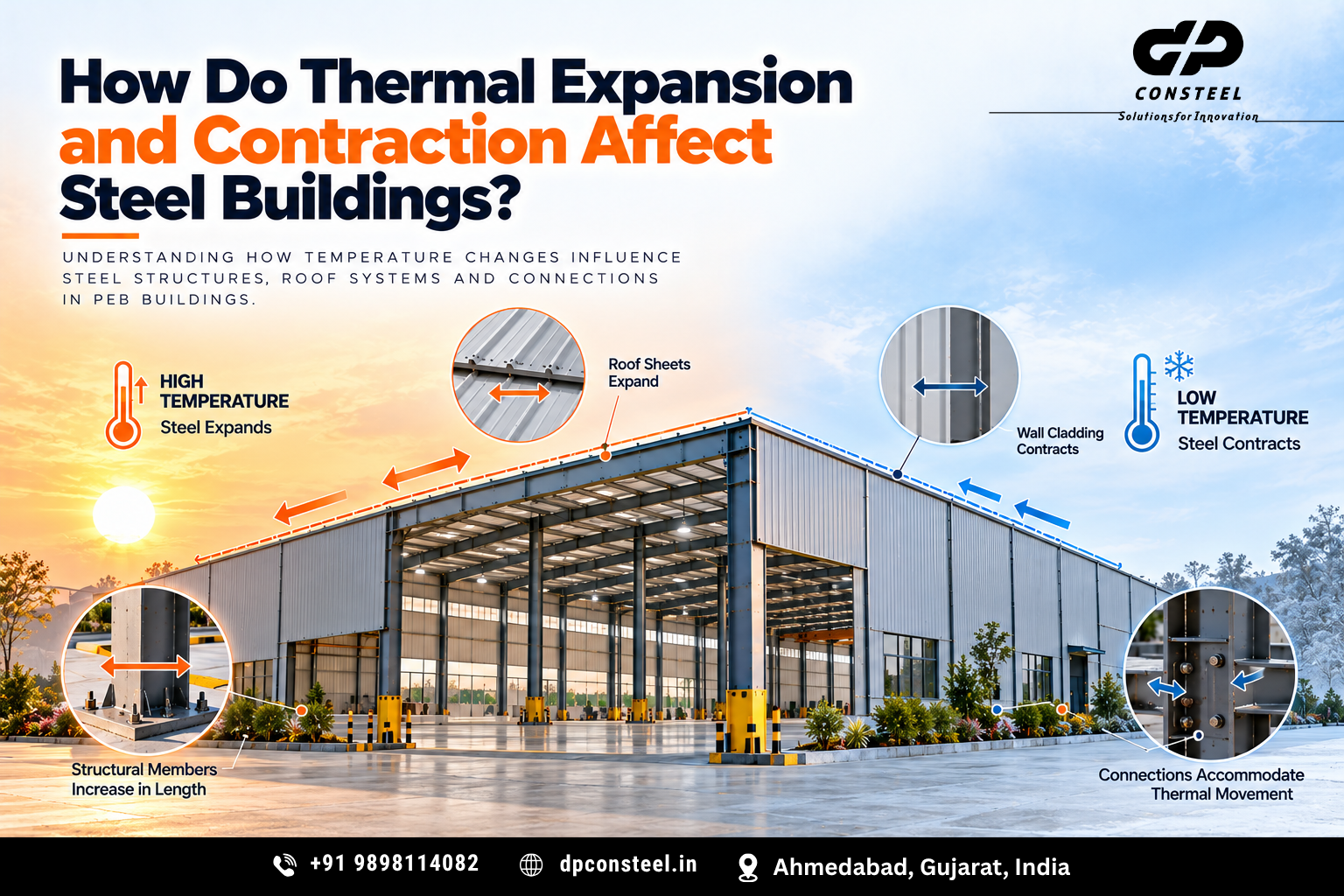
How Do Thermal Expansion and Contraction Affect Steel Buildings?
Thermal Expansion in Steel Buildings: Causes, Effects & Design
Learn how thermal expansion and contraction affect steel buildings, including dimensional changes, structural movement, connection design, roof systems, and temperature-related considerations in PEB structures.
How Do Thermal Expansion and Contraction Affect Steel Buildings?
Steel structures are exposed to changing temperatures throughout the year. During hot weather, steel expands as its temperature increases. When the temperature drops, steel contracts. Although these changes are normal material behaviour, they need to be considered when designing large industrial buildings.
In warehouses, factories, and pre-engineered buildings (PEBs), temperature variations can affect long steel members, roof systems, wall cladding, and structural connections. The amount of movement depends on the length of the member, the temperature change, and how the structure is supported.
Understanding thermal movement during the design stage helps engineers develop suitable structural arrangements and detailing. It also helps prevent avoidable problems during fabrication, installation, and building operation.
For industrial projects, an experienced PEB Structure Manufacturer in Ahmedabad considers relevant temperature effects alongside structural loads, building dimensions, and connection requirements.
What Is Thermal Expansion and Contraction in Steel?
Thermal expansion occurs when steel increases in length as its temperature rises. Thermal contraction occurs when steel decreases in length as it cools.
Steel does not expand or contract by the same total amount in every situation. The movement depends on three main factors:
-
Member length: Longer steel members generally experience greater total movement.
-
Temperature variation: A larger temperature change produces greater expansion or contraction.
-
Structural restraint: Connections and supports influence whether the movement can occur freely or generates additional forces.
For example, a 50-metre steel member experiencing a temperature change of 40°C may undergo approximately 24 mm of free thermal movement. The actual behaviour of an installed building depends on its structural arrangement and support conditions.
Why Does Temperature Affect Steel Buildings?
Steel absorbs heat from sunlight and its surroundings. Roof members exposed to direct sunlight may reach different temperatures from shaded structural components.
At night or during cooler weather, the steel loses heat and contracts. These changes can occur daily as well as seasonally.
In large industrial buildings, temperature conditions may vary across the roof, walls, and structural frame. Engineers need to consider these conditions when they influence the building's structural behaviour or building-envelope systems.
How Does Thermal Expansion Affect Long-Span Steel Structures?
Long-span steel structures require particular attention because their dimensions can allow greater total thermal movement.
Large warehouses, manufacturing facilities, and industrial sheds often contain long roof members and extensive cladding systems. Temperature-related movement can influence the way these components interact with their supports and connections.
The design must account for the intended structural behaviour, building length, temperature range, and applicable engineering requirements.
A qualified PEB Manufacturer in Ahmedabad can coordinate these considerations during structural design and detailing.
How Does Thermal Movement Affect Structural Connections?
Structural connections transfer forces between steel members. When temperature changes cause a member to expand or contract, the movement can generate additional forces if it is restrained.
The effect depends on the type of connection, the stiffness of the structure, and the movement permitted by the design.
Connections therefore need to be detailed according to their intended function. Some connections are designed to provide rigidity, while others may accommodate particular movements where required.
Correct connection detailing helps ensure that thermal effects are considered without compromising the structural system.
What Is the Role of Expansion Joints?
Expansion joints are designed to accommodate relative movement between building sections where required.
They may be considered for long buildings or structures where temperature-related movement needs to be managed through the structural arrangement.
The requirement for an expansion joint depends on the building's dimensions, configuration, support conditions, and design criteria. It is not necessary to provide the same joint arrangement in every steel building.
The location and detailing of expansion joints should be determined through appropriate engineering assessment.
How Does Thermal Expansion Affect Metal Roofing?
Metal roofing is exposed to sunlight and changing outdoor temperatures. As the roof heats up, its components expand. When the temperature decreases, they contract.
Repeated movement can affect roof sheets, fasteners, flashing, laps, and joints if the roofing system is not designed and installed to accommodate the expected movement.
The roofing system should therefore be selected and detailed according to the manufacturer's recommendations and the building's environmental conditions.
How Does Temperature Affect Wall Cladding?
Metal wall cladding also experiences thermal movement. Changes in temperature can affect panel dimensions and the movement of fasteners and joints.
If movement is improperly restrained, it may contribute to distortion, buckling, damaged sealants, or stress around fixing points.
Appropriate cladding details and fastening arrangements help accommodate the expected movement while maintaining weather protection.
How Do Engineers Manage Thermal Movement in PEB Buildings?
Thermal movement is addressed through a combination of structural design, connection detailing, and building-envelope coordination.
Depending on the project, engineers may consider:
Expected temperature ranges and the resulting movement of steel members.
Building length, structural layout, and support conditions.
Connection behaviour and the possibility of restrained movement.
Roof and wall cladding requirements.
Expansion joints or other movement provisions where necessary.
An experienced PEB Structure Manufacturer in Gujarat can coordinate these requirements with the approved design and fabrication drawings.
Does Thermal Expansion Affect Steel Fabrication?
Temperature can also affect steel components during manufacturing.
For example, welding introduces heat into a local area of steel. As the welded area cools, it contracts, potentially causing residual stresses or dimensional distortion.
Fabrication teams manage these effects through suitable welding procedures, assembly methods, sequencing, and dimensional checks.
This is different from the overall thermal movement of a completed building, but both considerations are relevant to steel fabrication quality.
How Does Thermal Expansion Affect Industrial Shed Design?
Industrial sheds often have extensive roof areas, long structural members, and large wall surfaces. Their design must account for the relationship between the structural frame and the building envelope.
The intended use of the building, its dimensions, roof configuration, and local environmental conditions influence the design requirements.
During Shed Manufacture, coordinating the steel frame, roofing, cladding, and connection details helps ensure that the components work together as intended.
What Problems Can Occur if Thermal Movement Is Ignored?
If relevant temperature effects are not adequately considered, a steel building may experience issues such as:
Unwanted stresses in restrained structural members.
Distortion or movement at roof and wall cladding joints.
Damage to sealants or flashing.
Difficulties at connections or interfaces between building components.
These problems are not inevitable. Their likelihood depends on the design, materials, installation quality, and operating conditions.
Proper engineering and suitable detailing help manage the risks.
Does Thermal Expansion Reduce the Strength of Steel?
Normal expansion and contraction caused by everyday temperature changes do not automatically reduce the strength of a steel structure.
However, when thermal movement is restrained, it can introduce additional forces or stresses that must be considered in the design.
Fire exposure is a separate and more serious condition because elevated temperatures can change steel's mechanical properties. Fire protection and structural fire design must therefore be addressed according to the applicable requirements.
How Can Thermal Movement Be Managed During Maintenance?
Regular inspection helps identify issues that may develop around roof joints, cladding fasteners, sealants, flashing, and other interfaces.
Maintenance teams should check for visible distortion, loose fixings, damaged seals, or deterioration around movement joints.
Any significant structural movement or suspected connection damage should be assessed by a qualified professional rather than corrected through improvised repairs.
Choosing a Manufacturer for a Thermally Considered Steel Building
When comparing PEB companies in Ahmedabad or PEB companies in Gujarat, businesses can consider the manufacturer's structural engineering capabilities, connection detailing, roofing systems, cladding arrangements, and quality-control procedures.
A manufacturer should be able to explain how the structural frame and building envelope are coordinated according to the project's design requirements.
For larger industrial projects, this coordination becomes particularly important because the structural system and roofing components may respond differently to temperature changes.
Frequently Asked Questions
1. Does every steel building need expansion joints?
No. Expansion joints are required only where the design and structural conditions indicate that they are necessary. Their need depends on factors such as building dimensions, temperature range, structural arrangement, and applicable design requirements.
2. Which parts of a PEB are affected by temperature changes?
Structural members, metal roof sheets, wall cladding, fasteners, connections, and other exposed components may experience thermal movement. The amount and effect of movement vary according to the material, temperature, and installation details.
3. Can thermal expansion cause roof leakage?
It can contribute to roof problems if joints, fasteners, flashing, or seals cannot accommodate the expected movement. Proper roofing design, installation, and maintenance help reduce this risk.
4. Why should thermal movement be considered before fabrication?
Considering thermal effects during design allows engineers and detailers to coordinate the structural frame, connections, and building envelope before manufacturing begins. This can reduce avoidable modifications during fabrication or installation.
Conclusion
Thermal expansion and contraction are natural properties of steel. In industrial buildings, temperature changes can influence structural members, connections, roofing, and wall cladding, particularly when long components or restrained movement are involved.
The key is to consider these effects during structural design, detailing, fabrication, and installation. Suitable connection arrangements, roofing details, movement provisions, and maintenance practices help manage thermal movement throughout the building's service life.
For businesses evaluating a PEB Structure Manufacturer in Ahmedabad, PEB Structure Manufacturer in Gujarat, or PEB Structure Manufacturer in India, the manufacturer's ability to coordinate structural engineering, connection details, roofing, and cladding is an important consideration.
When comparing a PEB Manufacturer in Ahmedabad, PEB Manufacturer in Gujarat, PEB Manufacturer in India, or different PEB companies in India, businesses should assess how the proposed building design addresses its actual environmental and operational requirements.
From structural planning to Shed Manufacture, a coordinated engineering approach helps ensure that thermal movement is considered as part of the complete steel building design.